Solo Ops Teams: Why One Person Can't Run Your Entire Revenue Engine (And What to Do About It) | JayOh
^ the bottleneck

Solo Ops Teams: Why One Person Can't Run Your Entire Revenue Engine

Your single-member ops team is stretched across every GTM function. The result? Burnout, missed opportunities, and systems held together by duct tape. Here's the framework to fix it.

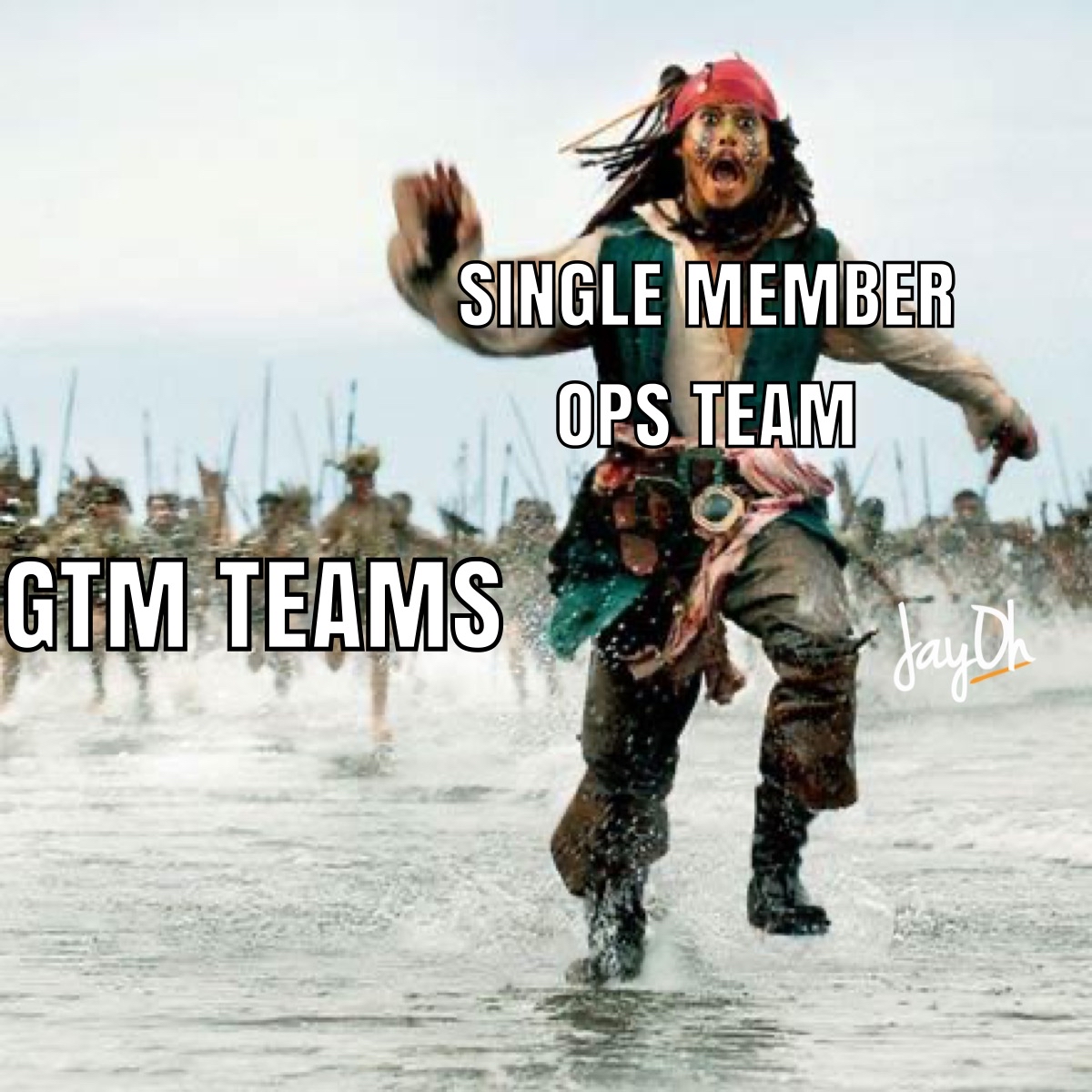
Solo ops team managing multiple GTM teams

Should you build, hire, or outsource your next ops investment?

Take the 2-Minute Decision Tool ↓
Running a Marathon With One Shoelace Untied

Ever felt like you're running a marathon with a single shoelace untied? That's what it's like when a single-member Ops team is trying to keep up with multiple GTM teams!

Here's the reality: while your GTM teams are zooming ahead with ambitious goals, your lone Ops person is frantically trying to keep everything from falling apart. This imbalance can lead to burnout, inefficiencies, and missed opportunities.

What if, instead of stretching one person thin, we could streamline workflows?

1. Automate Repetitive Tasks: Invest in automation tools to handle data entry and routine processes. It frees up valuable time for strategic thinking and innovation.

2. Enhance Collaboration: Implement collaboration platforms that allow for seamless communication and information sharing. Integration across teams can reduce the operational bottleneck.

3. Build a Cross-Functional Team: Cross-training members from GTM teams in Ops can create a more agile and resilient operation, spreading out the workload evenly and fostering better understanding among teams.

By embracing these strategies, not only do we ease the pressure on the Ops team, but we also enhance overall efficiency and productivity. Let's not just survive the race; let's thrive together.

#RevOps #GTM #Automation #Collaboration #Efficiency #Teamwork #Productivity

The Solo Ops Crisis: A Systems Problem

Solo ops team scaling is the practice of expanding operations capacity beyond a single individual to match the demands of multiple go-to-market teams. When a single ops person is responsible for supporting marketing, sales, and customer success simultaneously, the result is predictable: bottlenecks multiply, systems degrade, and the ops function becomes a constraint on revenue growth rather than an accelerant.

This isn't a people problem. It's a systems architecture problem. The same way you wouldn't run production infrastructure on a single server with no redundancy, you shouldn't run your entire revenue engine through one human being with no leverage.

The data is clear: companies with dedicated RevOps teams grow revenue 19% faster and are 15% more profitable than those without (Forrester). Yet the median B2B SaaS company under $50M ARR still operates with 1-2 ops people supporting 20-40 GTM team members.

Your Ops Function Is Failing If:

  • Your ops person spends more than 60% of their time on reactive requests instead of system-building
  • CRM data quality scores are below 80% accuracy across required fields
  • It takes more than 48 hours to fulfill a reporting request from leadership
  • More than 3 active GTM teams share a single ops resource with no triage system
  • You've had zero process automation improvements shipped in the last 90 days
  • Your ops person's backlog has more than 30 open items with no prioritization framework

Common Solo Ops Breakdowns

IssueRoot CauseFix
Reports are always late Ops person is building reports manually because no BI layer exists Invest in self-serve dashboards; automate recurring reports
CRM data is unreliable No validation rules, no automation on data entry, no audit cadence Deploy field-level validation + automated hygiene workflows
GTM teams bypass ops Ops is seen as a bottleneck, not an enabler Create an intake system with SLAs; publish a capacity dashboard
Tech stack is fragile Integrations were built ad-hoc with no documentation Map the integration architecture; prioritize critical-path redundancy
Ops person burns out Unlimited scope, zero boundaries, no prioritization from leadership Implement a sprint model with executive-backed prioritization

The pattern is consistent: solo ops teams fail not because the person isn't capable, but because the system around them isn't designed for leverage. They're doing the work of three people with the tools and authority of one.

"The question isn't whether your ops person is good enough. The question is whether your org has given them the architecture to actually scale. One person can build a system. One person cannot be the system."

Repeat after me: solo ops team scaling is not about finding a superhuman. It's about building the right combination of automation, external support, and internal cross-training so that the ops function can serve the revenue engine without being the single point of failure.

The JayOh Ops Leverage Framework

Four pillars for scaling operations without scaling headcount linearly.

1

Automate First

Before you hire, automate. Identify every recurring task your ops person does more than twice a week. Data entry, report generation, lead routing, lifecycle stage updates — if it follows a rule, it should be a workflow. Target: 40% of ops workload should be automated within 90 days.

2

Integrate Deeply

Fragmented tools create fragmented ops. Map your entire tech stack, identify every manual data transfer, and replace it with a native integration or middleware. Every manual handoff is a failure point. Target: zero manual data transfers between core systems.

3

Cross-Train Broadly

Your GTM team members should own basic ops hygiene within their domain. Sales reps own their CRM data. Marketers own their campaign tagging. CS owns their health score inputs. Ops becomes the architect, not the laborer. Target: 3+ GTM team members trained on ops basics per quarter.

4

Scale Strategically

When you do add ops capacity, make the right call: build internal automation, hire a second ops hire, or bring in a fractional/outsourced ops partner. Each has different ROI profiles depending on your stage, budget, and complexity. This is where the decision tool below helps.

Ops Leverage Metrics That Matter

Ops Leverage Ratio
GTM Headcount ÷ Ops Headcount
Target: ≤ 15:1. Above 20:1, you're running on borrowed time.
Automation Coverage
Automated Tasks ÷ Total Recurring Tasks × 100
Target: ≥ 40%. Below 20% means your ops person is doing robot work.
Ops Request SLA
Median Time from Request → Delivery
Target: ≤ 24 hours for standard requests. ≤ 4 hours for urgent.
Cost of Ops Bottleneck
(Delayed Deals × Avg Deal Size) + (Manual Hours × Loaded Cost/Hr)
Benchmark: The average bottleneck costs $8K-$15K/month in lost velocity.

These aren't vanity metrics. Each one directly maps to revenue impact. An ops leverage ratio above 20:1 correlates with 2.3x longer sales cycles (SiriusDecisions). Low automation coverage means your highest-paid ops talent is doing data entry. And every hour of SLA delay on a reporting request is an hour your leadership team is making decisions on stale data.

Ops Team Maturity Model

Where does your ops function sit today?

LevelNameCharacteristicsTypical Impact
1 Reactive One person, no systems, pure firefighting. Every request is ad-hoc. No documentation, no prioritization. High burnout, 40%+ data quality issues, 3-5 day report turnaround
2 Stabilizing Basic intake process exists. Some automation in place. CRM has partial validation rules. Backlog is visible. Reduced chaos, 24-48hr SLA on standard requests, 70-80% data accuracy
3 Systematic Sprint model active. 30%+ automation coverage. Self-serve dashboards for leadership. Cross-training started. Ops becomes proactive, 85%+ data quality, strategic projects begin shipping
4 Scaled 2+ ops resources (internal or fractional). Full integration architecture documented. GTM teams own their data. Sub-4hr SLA, 90%+ data quality, ops drives strategy not just execution
5 Engineered Ops is a true growth engine. Predictive analytics, full funnel visibility, automated escalation. Continuous improvement culture. 19% faster revenue growth, 15% higher profitability, ops is a competitive advantage

Solo Ops Operating Cadence

Even with one person, structure creates leverage. Here's the operating rhythm.

CadenceActionsOwner
Daily Triage incoming ops requests (15 min). Run automated data hygiene checks. Review integration error logs. Ops Lead
Weekly Sprint standup with GTM leads (30 min). Review ops backlog priorities. Ship 1-2 automation improvements. Update capacity dashboard. Ops Lead + GTM Leads
Monthly Ops leverage ratio review. Data quality scorecard. Automation coverage audit. Publish ops impact report to leadership. Ops Lead + VP/CRO
Quarterly Full tech stack audit. Cross-training sessions for GTM teams. Build vs. hire vs. outsource evaluation. Ops roadmap refresh. Ops Lead + Leadership
Annual Ops maturity assessment. Budget planning for ops investment. Integration architecture review. Vendor evaluation. Ops Lead + Finance + Exec Team

Build vs. Hire vs. Outsource Decision Matrix

Answer 6 questions. Get a data-driven recommendation for your next ops investment.

1. Monthly Budget Available for Ops Scaling
How much can you invest per month in additional ops capacity?
$0-2K $15K+ 5
2. Urgency of Need
How quickly do you need the additional ops capacity online?
6+ months This week 5
3. Technical Complexity of Ops Needs
How specialized is the work? Basic CRM admin vs. complex integration architecture.
Basic Highly complex 5
4. Internal Technical Capability
Does your current team have the skills to build automation and integrations?
None Expert 5
5. Volume of Recurring vs. Project Work
Is the ops need ongoing daily work, or a set of defined projects?
All projects All recurring 5
6. Institutional Knowledge Requirement
How much does this work depend on deep understanding of your specific business context?
Generic Deeply specific 5

Build (Automate Internally)

0
Fit Score

Hire (Add Ops Headcount)

0
Fit Score

Outsource (Fractional / Consultancy)

0
Fit Score

Most teams don't have a headcount problem.

They have a leverage architecture problem.

One person with the right systems will outperform three people duct-taping spreadsheets together. Build the system first. Then scale the people.

Ready to Engineer Your Ops Leverage?

We help B2B companies build the systems that turn solo ops into scalable growth engines.

Let's Talk
JayOh
Your Growth Partner — We Engineer Growth Systems