Scope discipline is the #1 predictor of AI build success. Here's how to enforce it.
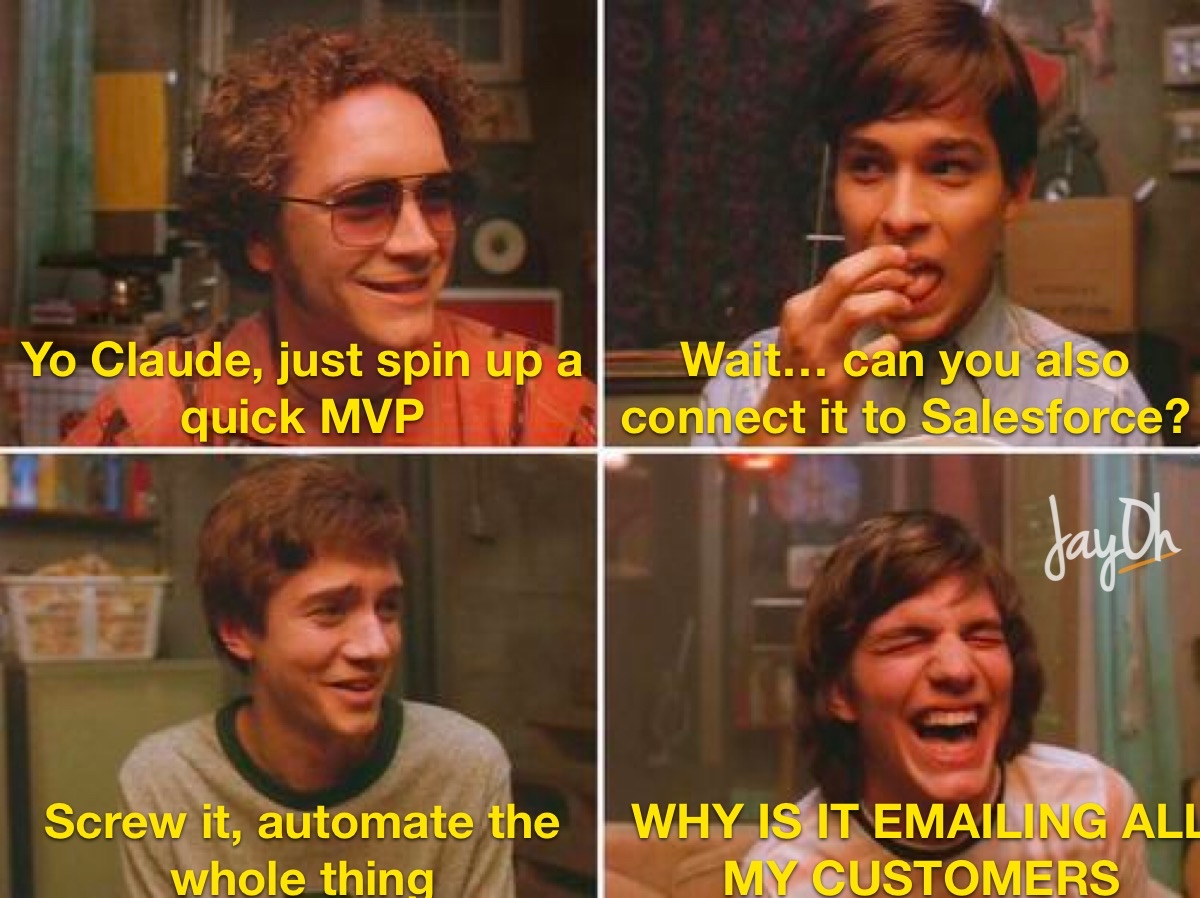
The most dangerous phrase in any AI build: "while you're at it..."
Starts with a clean scope. Automate lead routing. Simple, defined, shippable in a day. Then — while you're at it — can it also sync to Salesforce? Update the contact record? Trigger the email sequence? Notify the AE in Slack?
A 4-hour build becomes a 3-week dependency chain with no documentation and one person who understands how it works.
I see this break AI initiatives constantly. Not because the technology failed — because the scope never had a wall.
The operators building durable AI systems set the boundary before they touch the tool. What does this do? What does it explicitly not do? Where does a human stay in the loop? Those questions get answered before a single prompt gets written.
Guardrails aren't a constraint on what you can build. They're what makes it safe to build fast.
#AIStrategy #Automation #RevOps #GTM #OperatorMindset
AI scope creep is the uncontrolled expansion of automation requirements during a build. It transforms a focused, shippable automation into a sprawling integration chain that nobody fully understands, documenting, or maintains. A 4-hour build becomes a 3-week dependency chain with tribal knowledge locked in one person's head.
This isn't a technology problem. Your AI framework didn't fail. Your infrastructure is solid. What broke was discipline.
| Issue | Root Cause | Fix |
|---|---|---|
| "While you're at it" requests | No visible scope document. Request feels low-cost to the asker. | Lock scope in writing before any tool use. Make the cost of additions visible: "That's +2 integrations, +3 days, +1 unknown." |
| Cascading dependencies you don't discover until launch | No dependency mapping. You test the automation in isolation. | Map every integration point before you build. Include failure modes: "If Salesforce sync fails, does the lead get dropped or queued?" |
| Only one person understands the full system | No documentation. Knowledge stays in the builder's context window. | Document before you deploy. Runbooks, decision trees, integration contracts. Enforce >90% coverage. |
| Scope expands 3x larger than original plan | No enforcement mechanism. Boundary-setting exists but isn't binding. | Ship-ready gates. Build gates locked until scope is frozen. Expansions require formal re-planning. |
| Build time multiplies beyond estimate | Estimating touches one system, but integration touches five. | Break estimation by integration count. Each new integration = +2-4 hours for testing, docs, error handling. |
Scope discipline is not about building less. It's about building predictably. It's about knowing before you start what you're building, what you're not building, and where humans stay in the loop.
Every hour spent re-planning a scope expansion is an hour not spent on the next automation. Every person who becomes a single point of failure is a key person risk. Every deployment without documentation is a tech debt compound interest charge.
Teams that enforce scope discipline ship 2.5x faster, hand off cleanly, and build stacking value across multiple automations. Teams that don't end up rebuilding the same integrations every six months because nobody remembers how they work.
The best automation builders I know don't write more code than others. They ask better questions before they write any code.
Ask these before you touch the tool. The time you invest answering them cleanly is the time you save in rebuild cycles, handoffs, and tribal knowledge loss.
Four pillars that keep automation projects from collapsing under scope weight:
Define what's in and what's explicitly out before touching any tool. Write it down. Share it. Lock it. Make the scope visible.
Trace every integration point and its failure modes. What breaks if system X goes down? Build the system to degrade gracefully.
Identify where automation stops and human judgment begins. Don't try to automate decisions. Route the exceptions to humans with context.
Clear criteria that determine when a build is done vs. when it's growing tentacles. Documentation, testing, knowledge transfer, then lock it.
You can't manage what you don't measure. These four formulas are your scope health checks:
Keep integrations tightly controlled. Each new integration multiplies complexity.
Estimate by integration. If your multiplier is 3x, scope is expanding mid-project.
Knowledge concentration is fragility. Spread understanding across teams.
If it's not documented, it doesn't exist. Code without docs is tech debt.
These numbers tie directly to revenue impact. Every 15% expansion rate increase adds ~3 weeks to your timeline. Every person carrying single-threaded knowledge is a departure risk. Every point of undocumented automation is a future emergency.
Where does your organization sit? Use this to benchmark and plan your evolution:
| Level | Characteristics | Typical Outcome |
|---|---|---|
| Reactive | No scope docs. Builds happen ad-hoc. "We'll figure it out as we go." | 4-hour build becomes 3-week crisis. High burnout. Tribal knowledge. |
| Emerging | Some scope docs exist but no enforcement. Requests still expand builds mid-project. | 2x time multiplier. Some knowledge transfer. Inconsistent outcomes. |
| Defined | Scope templates exist. Sometimes followed. Documentation is spotty but improving. | 1.5x time multiplier. Patterns emerging. Better handoffs. |
| Managed | Scope gates enforced. Builds are documented. Integration mapping is standard. | 1.2x time multiplier. Predictable outcomes. Knowledge spreads. Scaling begins. |
| Optimized | Automated scope governance. Continuous improvement. Failure modes are modeled before build. | <1.1x multiplier. Shipping at pace. Zero tribal knowledge. Compounding value. |
Embed these rhythms into your build process to keep scope discipline automatic:
| Cadence | Action | Owner |
|---|---|---|
| Daily | Stand-up review: Did scope expand? Any new dependencies discovered? | Build lead |
| Weekly | Scope freeze check. Lock boundary. Document integrations added. Review single-threaded risk. | Build lead + stakeholder |
| Before Shipping | Ship-ready gates: Docs complete. 90%+ coverage. 2+ people understand it. Runbook locked. | Build lead + PM |
| Monthly | Metrics review. Calculate expansion rate, time multiplier, documentation coverage. Flag trends. | Operations + leadership |
| Quarterly | Maturity model check-in. Plan next-level investments. Knowledge transfer roadmap. | Leadership |
Should you add this feature to your current scope or defer it? Evaluate using 6 weighted criteria. Get a clear recommendation: Ship It, Defer It, or Kill It.
Let's talk about how to embed scope discipline into your automation practice.
Let's Talk