Workflow errors aren't minor inconveniences — they're compounding revenue leaks that scale with your team.
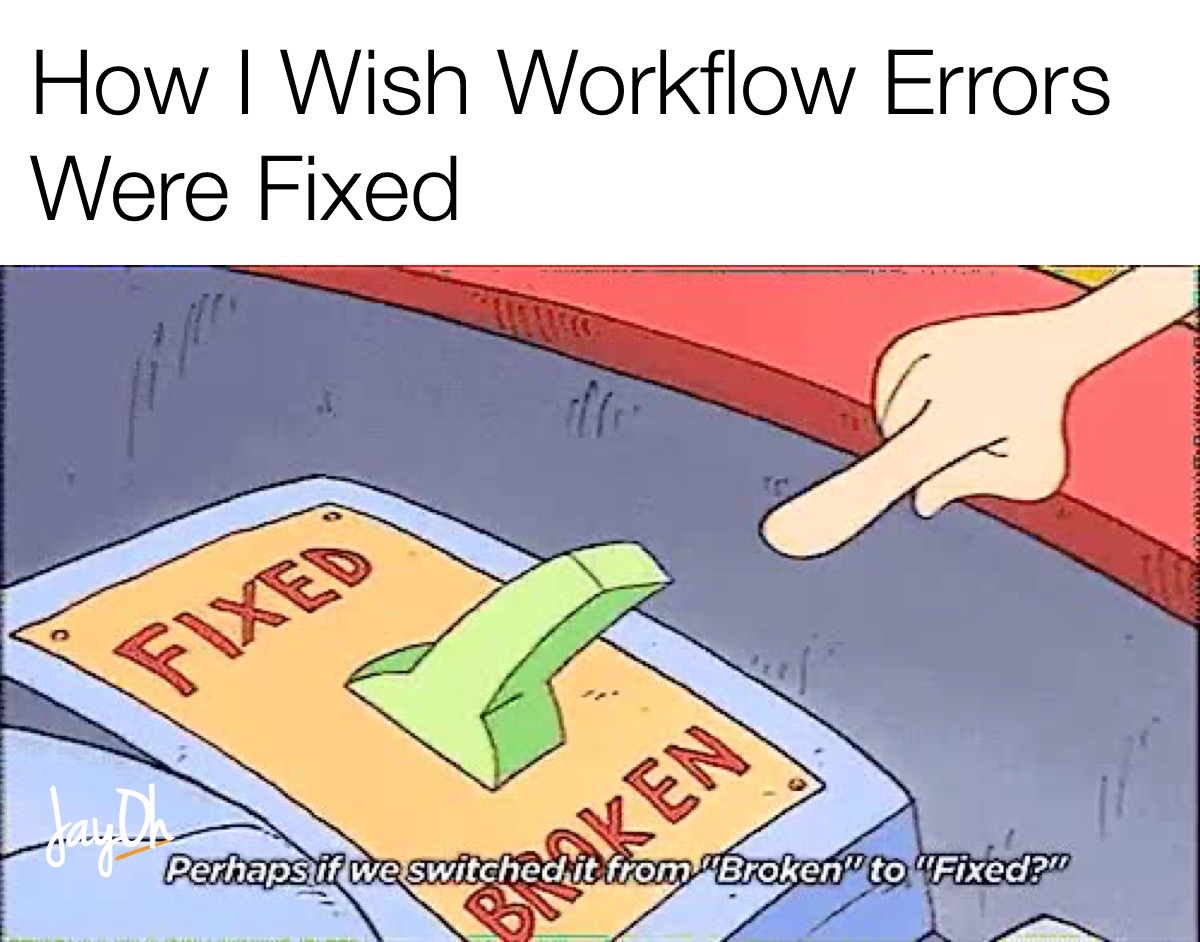
🔄 Ever wish you could fix workflow errors with just a flick of a switch? Workflow issues are more than just minor annoyances; they can bottleneck productivity, derail projects, and frustrate teams. Imagine a smoother, more efficient day-to-day operation where errors are minimized and processes run like clockwork. 🕰️ So, what's the secret sauce for achieving this efficiency? It's all about comprehensive workflow audits and intelligent automation. 🌟 1. **Audit Your Workflows Regularly** 🔍 - Identify the weak links and friction points in your processes. Understand where bottlenecks occur and why. 2. **Invest in Automation** 🤖 - Implement automation tools to handle repetitive tasks, reduce human error, and free up your team for more strategic work. 3. **Continuous Monitoring and Optimization** 📈 - Use metrics and KPIs to constantly evaluate the performance of your workflows. Make iterative improvements based on data-driven insights. By staying proactive and leveraging the right technology, you can ensure your operations run seamlessly, bringing your team both relief and a sense of accomplishment. 😊✨ #WorkflowOptimization #Automation #ProductivityHacks #BusinessEfficiency #RevOps
Workflow optimization is the practice of systematically identifying, analyzing, and eliminating inefficiencies in business processes. It's not about doing more — it's about extracting maximum value from every process step, every team member, and every dollar spent. At scale, workflow inefficiency compounds. A 5-minute daily delay multiplied across 10 team members and 250 working days equals 200+ hours of lost productivity annually. For a fully-loaded cost of $75/hour, that's $15,000 in annual waste from a single process gap.
More than 1 in 20 tasks require rework. This signals missing validation gates or unclear SOPs.
Processes take twice as long as they should. Bottlenecks, handoff delays, or approval loops are killing throughput.
More than 40% of your steps are manual. High-volume tasks should be 70%+ automated.
Your team can't articulate where work gets stuck. Without visibility, you can't optimize.
You measure effort, not impact. You can't improve what you don't measure.
Adding headcount degrades quality or speed. Your process architecture isn't built for scale.
| Workflow Issue | Root Cause | Fix |
|---|---|---|
| High rework rate | Unclear acceptance criteria or insufficient validation | Build automated QA gates; document success criteria |
| Slow cycle time | Sequential handoffs; bottleneck owner; approval delays | Parallelize steps; reduce approval layers; automate gates |
| Human errors spike | Manual data entry; ambiguous instructions; fatigue | Auto-populate from source systems; add guardrails; automate |
| Inconsistent execution | No documented SOP; interpretation variance | Document + version SOPs; train on playbook; audit execution |
| Team doesn't follow process | Process is painful or unclear; shortcuts are easier | Simplify steps; remove friction; make compliance effortless |
The cost of workflow failure compounds faster than you think. A single revenue operations team handling 500 pipeline updates monthly with a 3% error rate loses 15 updates per month. At $10K average deal value, that's $150K in monthly visibility gaps. Scale that across your GTM function, and you're looking at millions in compounding losses.
The real power of workflow optimization isn't incremental — it's exponential. When you combine process clarity, intelligent automation, and continuous measurement, you unlock what we call "operational leverage." Your team runs faster, mistakes drop, and your organization becomes genuinely scalable.
Most teams intuitively know they have workflow problems. They feel the friction. But they're treating symptoms (rushing people, hiring more staff) instead of curing the disease (the process itself). The teams winning in RevOps, Customer Success, and GTM aren't just executing faster — they've engineered their workflows to fail gracefully, catch errors automatically, and optimize continuously.
"Most teams don't have a workflow problem. They have a systems architecture problem."
Start by documenting every step, every decision point, every handoff, and every data move. You need a complete map of your current state before you can optimize. This includes identifying where decisions are made, who owns each step, and where data flows between systems. Most teams skip this and pay for it later.
Build instrumentation into your workflows. Track cycle time, error rate, automation coverage, and rework rate. You can't optimize blind. Create dashboards that show real-time process health. This is where operational visibility gets created.
Identify the 20% of steps driving 80% of time waste. Focus automation efforts on high-volume, low-complexity tasks. Use conditional logic to route work intelligently. Automate the repetitive; preserve human judgment for edge cases.
Set up real-time alerts for process degradation. Create weekly hygiene reports. Establish process SLAs. Your operation is only as good as your ability to detect and respond to drift. Continuous monitoring prevents small problems from becoming crises.
Treat workflow optimization as ongoing product development, not a one-time project. Run 2-week optimization sprints. Implement one high-impact improvement per sprint. Measure the delta. Ship. Move to the next bottleneck.
Measures the percentage of time spent on activities that directly create value. Anything below 75% indicates friction, wait time, or rework cycles that can be eliminated.
Tracks defects that escape your process controls. Above 2%, you're burning cycles on rework. Below 1%, you've built robust guardrails.
Percentage of process steps that run without human intervention. Below 60%, you're leaving labor dollars on the table. Above 80%, you've reached optimization maturity.
How much longer your process takes compared to the theoretical minimum. A ratio of 1.5x means you're 50% slower than optimal — usually due to wait time and parallelization opportunities.
| Level | Name | Characteristics | Typical Impact |
|---|---|---|---|
| 1 | Ad Hoc | Processes are informal, undocumented, and inconsistently executed. Each team member does their own thing. No metrics, no visibility. | High error rate (>10%), slow cycles, team friction, unpredictable output |
| 2 | Defined | Documented SOPs exist. Processes are repeatable but still largely manual. Basic error checking present. Team follows playbooks. | Error rate 5-10%, consistent execution, moderate efficiency loss to manual work |
| 3 | Managed | Key metrics are tracked. Processes are monitored in real-time. ~40-60% automation coverage. Optimization cycles happen quarterly. | Error rate 2-5%, faster cycles, operational visibility, some automation wins |
| 4 | Optimized | 60%+ automation. Metrics drive continuous improvement. Processes are self-healing (errors caught automatically). Weekly optimization sprints. | Error rate <2%, fast cycles, high efficiency, cultural adoption, measurable ROI |
| 5 | Autonomous | 80%+ automation. AI-driven optimization. Processes adapt dynamically. Humans focus on strategy and edge cases only. | Error rate <0.5%, fastest cycles, maximum efficiency, strategic advantage, exponential scaling |
| Cadence | Actions | Owner |
|---|---|---|
| Daily | Process health check; flag errors; triage blockers; review overnight automation runs; communicate blockers to team | Process Owner |
| Weekly | Hygiene review (metrics review); error analysis; RCA for >2 similar errors; identify quick-fix automation opportunities; team sync on optimization blockers | Process Owner + Team Lead |
| Monthly | Capacity planning; trend analysis; SLA review; stakeholder comms; prioritize next sprint of optimizations | Director / Function Lead |
| Quarterly | Architecture review; roadmap planning; technology evaluation; ROI calculation of optimizations; strategic optimization opportunities | Director + Exec |
| Annual | System audit; make vs. buy evaluation; training program refresh; process redesign opportunities; align to company growth targets | CRO / COO + Team |
Question 1 of 15 — Answer based on your team's typical week
Let's talk about where you're losing capacity and how to get it back.
Let's Talk