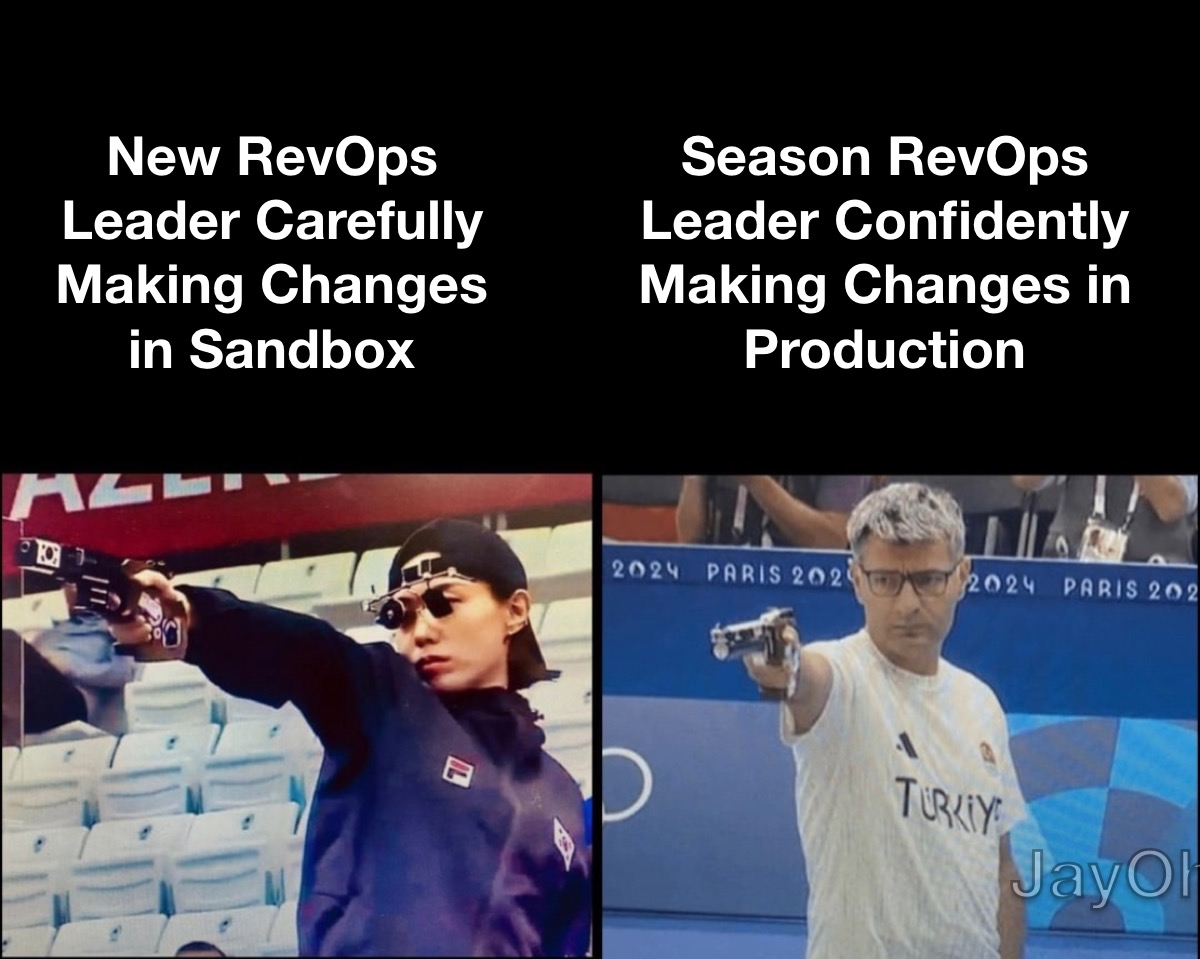
Seasoned operators and new leaders don't just think differently — they build differently. Here's why that gap is costing you revenue, and how to close it.
→ the confidence gap is a system problem
Are you leading like a seasoned operator or a cautious newcomer?
Take the 15-Second Pulse Check ↓RevOps leadership style is the behavioral pattern a revenue operations leader uses to make decisions, manage change, and drive system adoption across sales, marketing, and customer success. Poor leadership calibration leads to either reckless system changes that break downstream processes, or paralysis that stalls the entire revenue engine.
The gap between a seasoned RevOps operator and a new one isn't just about knowledge — it's about decision velocity. Seasoned leaders have failed enough times to know which risks are worth taking. New leaders haven't built that scar tissue yet, so every change feels existential. Both modes have failure states: overconfidence breeds blind spots, overcaution breeds stagnation.
| Issue | Root Cause | Fix |
|---|---|---|
| Changes break downstream | Overconfident leader skips impact mapping | Mandatory pre-change impact checklist with 3-system trace |
| Nothing ever ships | Cautious leader needs "perfect data" before acting | Implement 70% confidence rule: ship when 70% sure, iterate on feedback |
| Team can't act autonomously | Unclear decision rights and risk thresholds | Publish a decision matrix: who owns what at which dollar/risk tier |
| Cross-functional misalignment | Leader optimizes for their comfort zone, not the system | Weekly 30-min cross-functional sync with shared OKR review |
| Innovation stalls | No sandbox environment for low-risk experimentation | Dedicate 10% of sprint capacity to "sandbox sprints" — test in isolation, deploy on evidence |
The most dangerous RevOps leadership failure isn't a bad decision — it's an invisible one. When a leader's style prevents the team from even surfacing options, the organization never knows what it lost. Revenue impact compounds silently: one delayed automation saves 12 minutes per rep per day. Multiply that across 40 reps over a quarter, and you've burned 14,400 hours of selling time you'll never get back.
This is the fundamental shift: moving from a personality-driven leadership style (some leaders are naturally bold, others naturally cautious) to a system-driven operating model where decision speed and risk tolerance are calibrated to the actual stakes, not the leader's comfort level.
Five pillars that turn leadership style from a personality trait into a repeatable system.
Map every recurring decision type to a speed tier: Tier 1 (act in <24 hrs, reversible, low blast radius), Tier 2 (decide within a week, moderate impact), Tier 3 (requires cross-functional review, high stakes). This eliminates the leader as bottleneck by giving the team a decision framework that works regardless of who's in the seat. Target: 80% of operational decisions should be Tier 1 or Tier 2.
Every proposed change gets a simple cost assessment: "What's the cost of getting this wrong?" vs. "What's the cost of waiting another week?" When the cost of inaction exceeds the cost of a mistake, you ship. This flips cautious leaders from "let me analyze more" to "the analysis says go." Seasoned leaders get a check against overconfidence: if the downside cost is >2x the delay cost, slow down.
Create a formal staging environment for every system change. New leaders get psychological safety — they can experiment without fear of breaking production. Seasoned leaders get accountability — even their "gut feel" changes get validated in sandbox first. Target: 100% of process changes run through sandbox for at least 48 hours before production deployment.
The biggest asset a seasoned leader has is pattern recognition from past failures. Document these as "Decision Precedents" — short write-ups of past decisions, their outcomes, and the reasoning behind them. New leaders get accelerated experience without the scar tissue. The organization retains institutional knowledge even when leaders change. Target: build a library of 20+ precedents within the first quarter.
Track decision outcomes monthly. For every decision made, log: what was decided, what was the confidence level at decision time, and what was the actual outcome. Over 90 days, patterns emerge: are you over-indexing on caution where outcomes show you could move faster? Are you being bold in areas where your track record suggests more diligence? This makes leadership calibration data-driven, not personality-driven.
Four formulas that quantify RevOps leadership effectiveness. If you can't measure it, you can't fix it.
These metrics connect directly to revenue impact. A DVI below 0.50 means half your operational improvements die on the vine. A BCS above 50% means your leader is the system's single point of failure. Track these monthly and watch leadership style shift from gut instinct to calibrated operation.
Where does your leadership operating system sit today?
| Level | Name | Characteristics | Typical Impact |
|---|---|---|---|
| 1 | Reactive | No decision framework. Leader is 100% bottleneck. Every change requires personal approval. No sandbox. | High revert rate (>30%), team paralysis, 4-6 week decision cycles |
| 2 | Personality-Driven | Decisions flow based on leader's default style (bold or cautious). Inconsistent speed. No precedent library. | Unpredictable outcomes, team can't anticipate direction, 2-4 week cycles |
| 3 | Structured | Decision tiers defined. Sandbox exists but isn't mandatory. Some precedents documented. BCS around 40%. | Improving velocity, revert rate 15-20%, 1-2 week cycles on Tier 2 |
| 4 | Calibrated | Risk pricing active. Confidence loop running monthly. Team handles 70%+ of decisions. Precedent library in use. | DVI >0.75, revert rate <12%, <1 week on Tier 2, team operates independently |
| 5 | Self-Correcting | System auto-calibrates. Data surfaces when leader should speed up or slow down. New leaders onboard in weeks, not months. | Near-zero bottleneck, continuous improvement, leadership transitions are seamless |
What to do, and when, to keep your RevOps leadership system running.
| Cadence | Action | Owner |
|---|---|---|
| Daily | Review Tier 1 decision queue — clear or escalate within 4 hours. Check sandbox status for any pending deployments. | RevOps Lead / IC |
| Weekly | 30-min cross-functional sync: review open Tier 2 decisions, surface blockers, align on priorities. Update decision log. | RevOps Lead + Sales/Marketing/CS Ops |
| Monthly | Confidence feedback loop review: score last month's decisions (confidence vs. outcome). Update risk pricing benchmarks. Review BCS and DVI metrics. | RevOps Lead + VP/Director |
| Quarterly | Full maturity model assessment. Add 5+ new decision precedents to library. Recalibrate decision tiers based on team growth and system complexity. | RevOps Lead + CRO/COO |
| Annual | Leadership operating model audit. Benchmark against industry. Plan next-level maturity targets. Stress-test: simulate leader departure — can the team sustain operations? | Executive Team |
Three questions. No fluff. Find out if you're operating like a seasoned leader, a cautious newcomer, or the rare balanced operator.
Most teams don't have a leadership problem. They have a leadership calibration problem — and they're paying for it in every decision that takes a week longer than it should.
We build the systems that make leadership style a feature, not a bottleneck.
Let's TalkWe engineer growth systems. JayOh builds the RevOps architecture, GTM execution and data infrastructure that turn messy revenue operations into predictable pipeline for B2B SaaS and PE-backed teams.