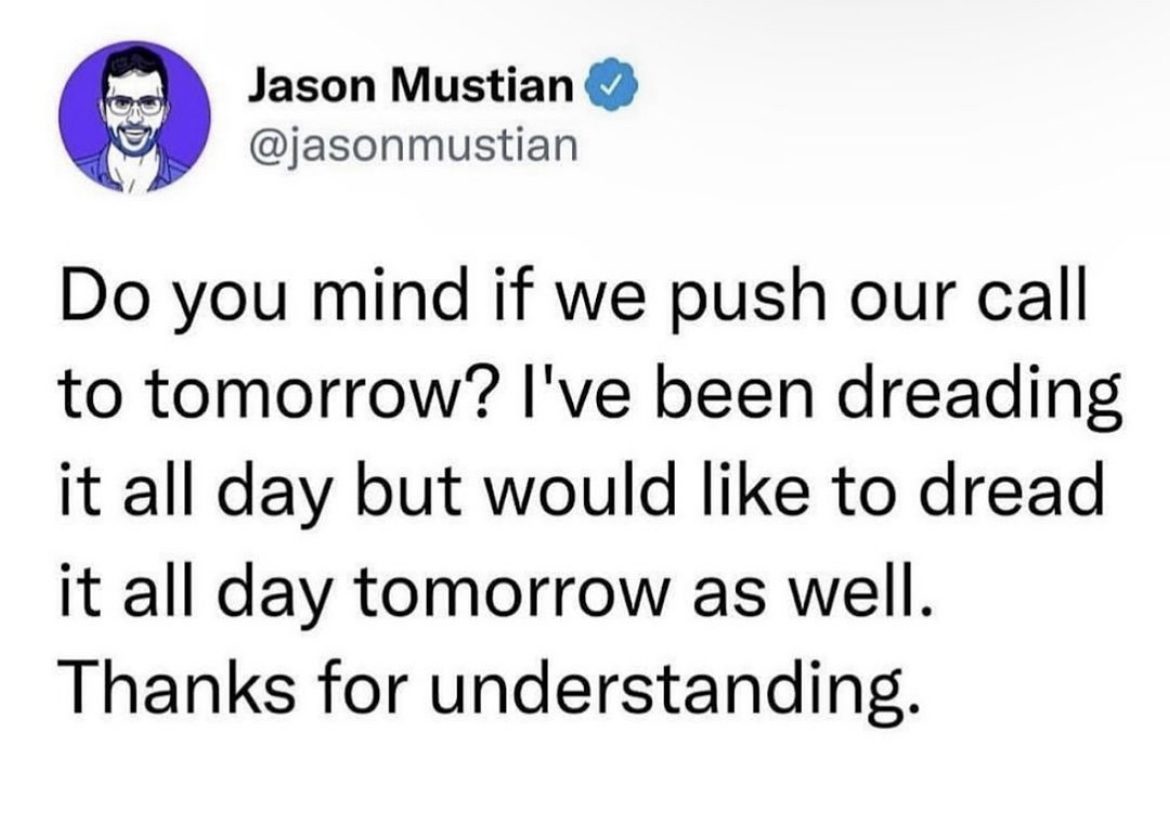
Picture this: you're deep in your flow state, building flows, launching new features & knocking out tasks. Everything's clicking, ideas are flowing, and you're on fire. Then—*ding*—a meeting invite drops in like a bomb.
Suddenly, that perfect flow shatters, and now you're anticipating that 30-minute call later that you know will completely throw off your day.
For a "maker", a meeting isn't just a tiny interruption—it's like hitting a mental speed bump at full throttle.
While "managers" thrive on a steady diet of back-to-back calls, for "makers", it's a productivity killer.
You can almost feel your brilliant ideas scattering like confetti, knowing it'll take forever to piece them back together after that "quick chat" is over.
Be aware of this when choosing who, how, and when you decide to schedule calls!
The Hidden Tax on Maker Productivity
Meeting overload is the practice of scheduling meetings without regard for their impact on deep-work capacity. Poor meeting hygiene leads to fragmented calendars, context-switching fatigue, and a systematic destruction of the cognitive blocks your highest-output team members need to produce revenue-generating work.
The distinction between "makers" and "managers" was first named by Paul Graham, but the operational consequences run deeper than most leaders realize. A maker — your RevOps architect, your automation engineer, your campaign builder — needs 3–4 hour uninterrupted blocks to produce meaningful output. A manager's calendar is naturally segmented into 30-minute blocks. When you impose a manager's cadence on a maker's calendar, you don't just lose the meeting time. You lose the entire block around it.
Research from Microsoft's WorkLab shows the average knowledge worker spends 57% of their time in meetings, emails, and chat. That leaves just 43% for actual work — and that 43% is typically fragmented into sub-60-minute windows, which are too short for deep work. The result: your most expensive talent is operating at a fraction of capacity.
Your Meeting Culture Is Failing If:
- More than 40% of your team's calendar is consumed by meetings in any given week
- Makers (engineers, architects, builders) have fewer than two 3-hour uninterrupted blocks per day
- Meetings are scheduled without agendas more than 25% of the time
- Recurring meetings haven't been audited in the last 90 days
- The average meeting has more than 5 attendees
- Your team dreads the calendar more than the actual work
Issue / Cause / Fix
| Issue | Root Cause | Fix |
|---|---|---|
| Makers can't finish deep work | Meetings scattered throughout the day | Batch all meetings into designated "manager hours" (e.g., 2–5 PM) |
| 30-min meetings kill 3-hour blocks | No calendar zoning policy | Implement "No Meeting Mornings" org-wide |
| Recurring meetings that add no value | No meeting audit cadence | Run a quarterly "Meeting Purge" — cancel, justify, or consolidate |
| Too many attendees per meeting | FOMO / lack of async summaries | Cap at 5 people + post async recap within 1 hour |
| Context-switching fatigue | Back-to-back calls with no buffer | Enforce 10-min buffers via calendar tool settings |
"Every meeting on a maker's calendar doesn't just cost 30 minutes. It costs the 90 minutes of ramp-up time on either side. A 'quick sync' is actually a 3-hour productivity tax."
The most dangerous meetings aren't the long ones — they're the short ones placed in the middle of a deep-work block. A 30-minute standup at 10:30 AM effectively eliminates both the 8–10:30 block (because the maker is anticipating the interruption) and the 11–12 block (because they need to re-enter flow state). One meeting. Three hours gone.
The JayOh Maker-Manager Alignment Framework
This framework provides the operating system for protecting deep work while maintaining the communication cadence your business requires. It has four pillars:
Pillar 1: Calendar Zoning
Divide every day into Maker Blocks (morning, 4 hours minimum) and Manager Blocks (afternoon). Maker Blocks are sacred — no meetings, no Slack pings, no "quick questions." Manager Blocks are where all syncs, standups, and collaborative sessions live. This single change typically recovers 8–12 hours of deep work per maker per week.
Pillar 2: Meeting Compression
Every meeting must pass the "3A Test": does it have an Agenda, an Action owner, and an Async alternative? If any answer is no, the meeting gets canceled or converted to an async update. Default meeting length drops from 30 to 25 minutes (or 50 instead of 60), enforced at the calendar-tool level. The goal is fewer, shorter, sharper meetings.
Pillar 3: Async-First Communication
Shift the default from "let's hop on a call" to "let me send a Loom/doc/Slack thread." Async communication creates a written record, respects time zones, and lets makers process information during their Manager Block instead of interrupting their Maker Block. Reserve synchronous time for decisions that require real-time debate.
Pillar 4: Quarterly Meeting Audit
Every 90 days, run a full audit of all recurring meetings. For each one, answer: What decision does this meeting drive? What would happen if we skipped it for 2 weeks? Who actually needs to attend? Meetings that can't justify their existence get killed. This prevents calendar creep — the slow accumulation of meetings that individually seem harmless but collectively devour your team's capacity.
Formulas & Benchmarks
Deep Work Ratio
Uninterrupted 3hr+ Blocks / Total Work Hours
Target: ≥ 40% for makers, ≥ 20% for managers
Meeting Load Index
Total Meeting Hours / Total Available Hours
Target: ≤ 30% org-wide, ≤ 15% for makers
Meeting ROI Score
(Decisions Made + Actions Created) / Meeting Hours
Target: ≥ 2.0 decisions per meeting hour
Flow State Recovery Cost
Avg Re-entry Time × Interruptions/Day × Hourly Cost
Benchmark: 23 min avg re-entry (UC Irvine). At $75/hr, each interruption costs ~$29.
When you do the math, a team of 5 makers interrupted 4x/day each is burning $580/day — roughly $150K/year — in lost productivity from context-switching alone. That number doesn't include the compounding cost of delayed projects, missed deadlines, and team burnout.
Meeting Culture Maturity Model
| Level | Name | Characteristics | Typical Impact |
|---|---|---|---|
| 1 | Chaos | No meeting norms. Anyone books anyone anytime. No agendas. | 40–60% of maker time lost. High turnover among builders. |
| 2 | Awareness | Leadership acknowledges the problem. Some "no meeting" days attempted sporadically. | 30–40% time lost. Inconsistent enforcement. |
| 3 | Structured | Calendar zoning in place. Meeting compression practiced. Agendas required. | 20–30% time lost. Makers get 2+ deep blocks/day. |
| 4 | Optimized | Async-first culture. Quarterly audits. Meeting ROI tracked. | 10–20% time lost. Output per maker up 30–50%. |
| 5 | Engineered | Meeting culture is a measured system. Deep Work Ratio is a KPI. Continuous improvement loop. | <10% time lost. Top-quartile team velocity. |
Operating System Cadence
| Cadence | Action | Owner |
|---|---|---|
| Daily | Enforce Maker Block boundaries. Post async standup in Slack (no live standup for makers). | Team Leads |
| Weekly | Review Meeting Load Index per team member. Flag anyone above 30%. | Ops Manager |
| Monthly | Audit Deep Work Ratio. Publish maker productivity scorecard. Address worst offenders. | RevOps Lead |
| Quarterly | Full Meeting Purge — cancel or justify every recurring meeting. Reset calendar zoning rules. | VP/Director |
| Annually | Benchmark Meeting Culture Maturity Level. Set targets for next tier. Update async tooling. | COO / CRO |