RevOps Fire Drills: Why Your Team Is Firefighting Instead of Growing (And How to Stop) | JayOh
// the reactive trap →

RevOps Fire Drills: Why Your Team Is Firefighting Instead of Growing

Every "urgent" fire your RevOps team puts out is a strategic initiative that doesn't ship. Here's how to break the cycle and build a fire-prevention operating system.

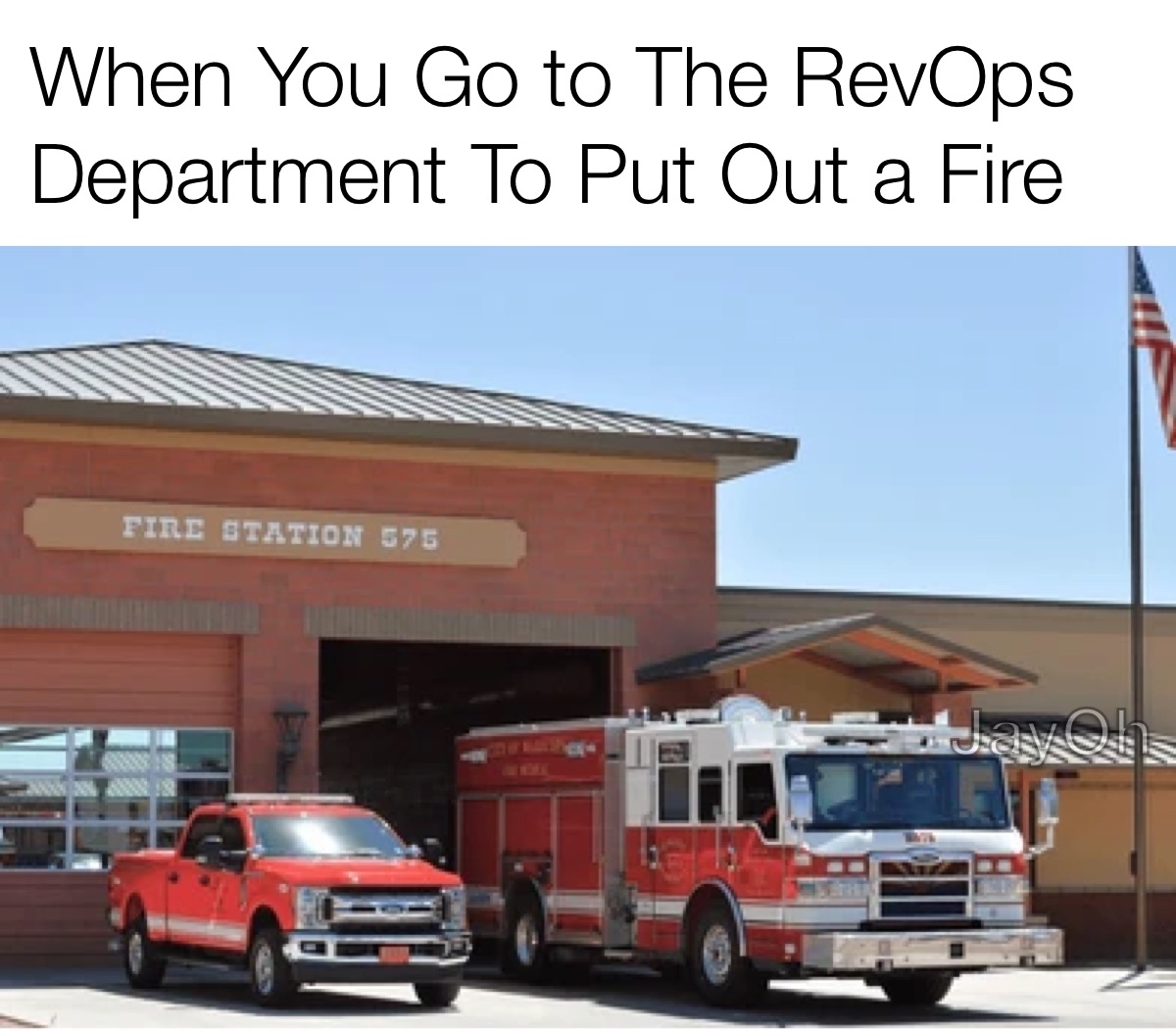
RevOps fire drill illustration showing reactive vs proactive operations
Every Day Is a Fire Drill in RevOps — But It Doesn't Have to Be
Ever feel like every day is a fire drill in the RevOps department? But what happens when the alarms keep going off and there's no end in sight? These "fires" can be anything from misaligned marketing campaigns to sales inefficiencies. These constant interruptions not only divert your team's focus from strategic projects but also create a chaotic work environment that can lead to burnout. The real issue? Many of these fires are preventable. Here's the secret sauce to fireproofing your RevOps department: 1. Centralized Data & Analytics: Keep all your performance metrics in one place. This creates a unified view, making it easier to spot potential issues before they turn into full-blown fires. 2. Standardized Processes: Develop clear, repeatable processes for common tasks. This not only boosts efficiency but also reduces confusion and errors. 3. Proactive Communication: Regular check-ins between marketing, sales, and operations can help identify potential sparks before they ignite. Use collaborative tools to keep everyone in the loop. 4. Continuous Training: Equip your team with the latest tools and methodologies. Continuous learning helps them stay ahead of the curve and tackle challenges more effectively. By implementing these strategies, you transform your RevOps team from fire-fighters to fire-preventers. This proactive approach not only saves time and resources but also fosters a more innovative and productive work environment. Plus, your team can finally focus on strategic growth initiatives rather than constantly putting out fires! So, RevOps leaders, it's time to trade in your fire helmets for strategic thinking caps. Let's reduce the chaos and build a more resilient operation.

The Firefighting Trap, Defined

RevOps firefighting is the state where a revenue operations team spends the majority of its capacity reacting to urgent, unplanned requests instead of executing strategic initiatives. Poor fire-prevention systems lead to chronic reactive mode, talent burnout, missed pipeline targets, and an inability to scale operations beyond the current team's heroics.

This isn't a workload problem. It's a systems architecture problem. When every day feels like an emergency, the root cause is almost never "we need more people." It's that the underlying processes, data infrastructure, and communication cadences weren't designed to catch problems before they escalate.

The cost is staggering. RevOps teams stuck in firefighting mode typically lose 30-40% of their strategic capacity to unplanned work. That's not just wasted hours — it's deferred revenue, compounding every quarter.

Your RevOps team is firefighting if:

  • More than 35% of your team's weekly work is unplanned or reactive
  • Stakeholder requests routinely override your sprint plan within the first 48 hours
  • The same category of "fire" has occurred 3+ times in the last 90 days
  • Your team has no documented triage framework — everything is "urgent"
  • Strategic projects have been pushed back 2+ sprints in a row
  • At least one team member has mentioned burnout or attrition risk in the last quarter

If three or more of those conditions are true, you're not operating — you're surviving. The difference between the two is the difference between a 15% and a 40% net revenue retention improvement. That's not hyperbole; it's what we've measured across dozens of mid-market B2B RevOps transformations.

Issue / Cause / Fix

Issue Root Cause Fix
Same fires keep recurring No root-cause analysis or postmortem process Implement a fire log + monthly pattern review to eliminate repeat incidents
Everything is "urgent" No triage framework or severity definitions Create a 4-tier severity matrix with SLA and escalation paths
Strategic work keeps slipping No capacity protection for planned work Reserve 60-70% of sprint capacity for planned work; cap reactive at 30%
Data issues cause downstream chaos No proactive data quality monitoring Build automated data quality dashboards with threshold-based alerts
Cross-functional misalignment No structured communication cadence Weekly ops sync with marketing, sales, and CS leaders + shared KPI dashboard
"The best RevOps teams don't fight fewer fires. They build systems where fires can't start."

The pattern is clear: firefighting isn't caused by bad luck or difficult stakeholders. It's caused by the absence of preventive systems. Every fire your team fights is a system that failed silently. The job of RevOps leadership isn't to build a faster fire truck — it's to fireproof the building.

When you shift from reactive to proactive, three things happen simultaneously: your team's utilization improves because planned work is more efficient than interrupt-driven work, your stakeholders' confidence increases because they see predictable delivery instead of heroic saves, and your pipeline metrics improve because strategic initiatives actually ship on schedule.

The JayOh Fire Prevention Framework

Five structural pillars that shift RevOps from reactive firefighting to proactive fire prevention.

1 Centralized Signal Layer

Unify all performance data, alerts, and operational metrics into a single pane of glass. When data lives in five different tools, "fires" are really just information asymmetry. Build a centralized ops dashboard that surfaces anomalies automatically — data quality drops, pipeline velocity changes, conversion rate shifts — before any human notices. Target: 90%+ of operational metrics visible in one view, refreshed daily.

2 Triage Architecture

Not every request is a fire. Build a 4-tier severity framework (Critical / High / Medium / Low) with clear definitions, SLA expectations, and escalation paths. Critical means revenue-impacting within 24 hours. Low means it can wait for the next sprint. When stakeholders have a shared language for urgency, the volume of "emergencies" drops by 40-60% overnight. Publish the triage matrix. Make it visible. Enforce it.

3 Capacity Protection Protocol

Hardcode a split: 65% planned strategic work, 25% reactive buffer, 10% continuous improvement. This isn't aspirational — it's an operating constraint. If reactive work exceeds 25% for two consecutive sprints, that's a system failure signal, not a "busy period." Track it. Visualize it. Escalate when the ratio breaks.

4 Proactive Communication Engine

Most fires are information gaps that became emergencies. Build a structured communication cadence: weekly ops syncs with cross-functional leaders, bi-weekly stakeholder readouts, monthly fire-pattern reviews. Every meeting has a pre-populated agenda driven by data, not feelings. The communication engine doesn't just share information — it catches sparks before they ignite.

5 Root Cause Elimination Loop

Every fire gets logged. Every fire pattern gets a postmortem. Every postmortem produces a system fix. Maintain a "Fire Log" — a simple tracker that records the incident, category, root cause, and resolution. Monthly, review the log for patterns. If the same fire type appears 3+ times, it graduates from "incident" to "system design failure" and gets a dedicated fix sprint. The goal: shrink the fire log by 20% every quarter.

The Numbers That Matter

Reactive Capacity Ratio
Unplanned Hours / Total Hours = RCR
Target: < 30%. Above 40% = systemic failure.
Fire Recurrence Rate
Repeat Fire Types / Total Fires = FRR
Target: < 15%. If >30%, your postmortem process is broken.
Strategic Delivery Rate
Planned Work Completed / Planned Work Committed = SDR
Target: > 80%. Below 60% = sprint plans are fiction.
Time to Detect (TTD)
Avg Hours Between Anomaly Onset & Alert Fired
Target: < 4 hours. Same-day detection prevents 70% of escalations.

These four metrics are the vital signs of your RevOps operating system. Track them weekly. When RCR spikes, it means your triage architecture failed. When FRR is high, your root cause loop isn't eliminating patterns. When SDR drops, your capacity protection broke. When TTD is slow, your signal layer has blind spots. Every metric points to a specific framework pillar — and a specific fix.

Fire Prevention Maturity Model

Where does your RevOps team sit today? Be honest — most teams are at Level 1 or 2.

Level Name Characteristics Typical Impact
1 Chaos Mode No triage framework. Every request is urgent. No fire logging. Reactive capacity >50%. Team in survival mode. 30-40% of strategic initiatives delayed or killed. High attrition risk. Stakeholder frustration chronic.
2 Aware but Reactive Basic severity definitions exist but aren't enforced. Some data centralization. No capacity protection. Occasional postmortems. 20-30% strategic work delayed. Team morale inconsistent. Some repeat fires addressed.
3 Structured Response Triage matrix enforced. Capacity split tracked. Fire log maintained. Weekly ops syncs. Reactive ratio 25-35%. Strategic delivery rate >70%. Team stability improving. Cross-functional alignment emerging.
4 Proactive Prevention Automated anomaly detection. Root cause loop active. Fire recurrence <15%. Communication engine running. Capacity protected. Strategic delivery >85%. Fire volume down 50%+ from baseline. Team focused on growth initiatives.
5 Self-Healing System Predictive alerting. Automated remediation for common issues. Fire log shrinking quarterly. Reactive ratio <15%. Team operates as strategic growth engine. 95%+ strategic delivery. Near-zero repeat fires. RevOps seen as competitive advantage by leadership.

The Fire Prevention Operating Cadence

A system only works if it runs on a rhythm. Here's the cadence that keeps the framework alive.

Frequency Action Owner
Daily Review anomaly dashboard for threshold breaches. Log any new fires in the Fire Log with severity and category. RevOps Analyst / On-Call
Weekly Cross-functional ops sync (Sales, Marketing, CS). Review reactive capacity ratio. Triage new requests against severity matrix. RevOps Lead
Bi-Weekly Sprint retrospective: check SDR, flag any capacity protection violations. Stakeholder readout on delivery progress. RevOps Manager
Monthly Fire pattern review: analyze Fire Log for repeat categories. Assign system-fix sprints for any 3+ occurrences. Update triage matrix if needed. RevOps Director
Quarterly Maturity model self-assessment. Benchmark RCR, FRR, SDR, TTD against targets. Set next-quarter fire prevention OKRs. VP RevOps / CRO

RevOps Fire Prevention Readiness Assessment

12 questions across 5 categories. Takes 2 minutes. Get your score and a prioritized action plan.

0 / 100

Your Prioritized Action Plan

Most RevOps teams don't have a workload problem.
They have a systems architecture problem.

Ready to Stop Firefighting?

We build the systems that prevent fires from starting.

Let's Talk

Your Growth Partner