RevOps Prioritization: Why Your Team Is Drowning in Stakeholder Requests (And How to Fix It) | JayOh

RevOps Prioritization: Why Your Team Is Drowning in Stakeholder Requests (And How to Fix It)

Every time you clear your RevOps backlog, another wave of "urgent" requests crashes in. The problem isn't capacity. It's the absence of a request governance system.

RevOps Prioritization - Stakeholder Request Management

How tight is your request management system? Take the 3-minute audit.

Run the Audit
Original LinkedIn Post

The Endless RevOps To-Do List

▼

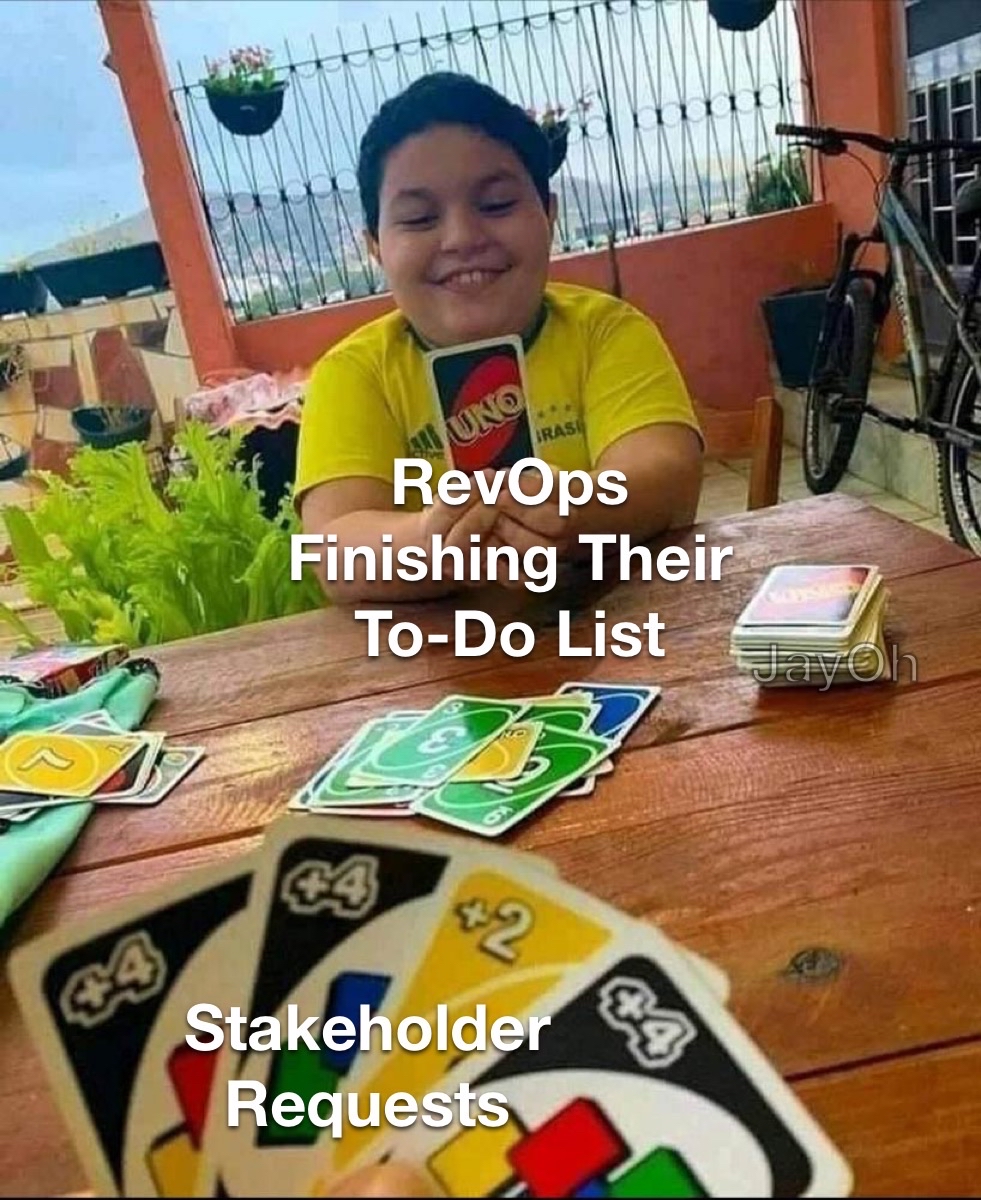
Ever feel like finishing your RevOps to-do list is like winning a game of Uno, only to be hit with stack of +4 wild cards? #RevOpsLife The eternal struggle of RevOps leaders: just when you think you've checked the last box on your list, another urgent stakeholder request lands on your desk. It's like trying to keep a boat afloat while more holes keep appearing. Here's the real kicker: constantly having to pivot and address surprise requests can lead to burnout, inefficiency, and stagnation in your strategic initiatives. Your team ends up in reactive mode rather than proactive growth mode. It's exhausting! So, what's the magic skip card to get through this endless loop? Prioritization with Transparent Communication & Strategic Alignment: 1. Set Clear Priorities: Sit down with stakeholders to discuss and align on key priorities and objectives. This ensures everyone is on the same page and understands why certain tasks take precedence. 2. Communicate Transparently: Regularly update your team and stakeholders on project progress and any shifts in priority. This minimizes misunderstandings and keeps everyone informed. 3. Empower Your Team: Provide your team with the tools and authority to address less critical requests independently, freeing up your time for high-impact tasks. The benefits? - Increased productivity and efficiency. - Improved team morale and reduced burnout. - Strategic alignment leading to better business outcomes. Let's transform the RevOps challenge into an opportunity to lead and innovate!

The RevOps Prioritization Problem

RevOps prioritization is the practice of systematically triaging incoming stakeholder requests against strategic objectives, available capacity, and expected business impact. Poor RevOps prioritization leads to reactive operations, burned-out teams, stalled strategic initiatives, and revenue leakage from misallocated effort. It is the single biggest operational bottleneck in scaling B2B companies.

Most RevOps teams don't fail because they lack talent or tools. They fail because they have no system for deciding what gets worked on, what gets queued, and what gets killed. The result: every request feels urgent, nothing gets prioritized, and the team operates in permanent firefighting mode.

Your RevOps prioritization is failing if:

  • More than 40% of your sprint capacity is consumed by unplanned requests
  • Your team can't articulate the top 3 strategic priorities for the current quarter
  • Stakeholder requests bypass any formal intake process more than 25% of the time
  • Average request-to-completion time exceeds 3 weeks for tactical items
  • You've moved the same strategic initiative's deadline 3+ times this quarter
  • Your RevOps leader spends more than 60% of their time in delivery vs. strategy
IssueRoot CauseFix
Every request is treated as urgentNo impact-scoring framework for incoming requestsImplement a request intake form with mandatory impact/effort fields
Strategic work keeps getting pushedNo protected capacity for non-urgent/high-impact workReserve 30-40% of sprint capacity as "strategic-only" blocks
Stakeholders go around the processNo consequences for bypassing intake; unclear SLAsPublished SLA tiers with explicit bypass penalties (queue reset)
Team burnout and turnoverChronic overcommitment without capacity visibilityCapacity dashboard visible to all stakeholders, updated weekly
Duplicate or conflicting requestsNo centralized request repository; siloed communicationSingle intake board (Asana/Jira) with dedup automation

The pattern is always the same. A well-intentioned RevOps team says yes to everything, capacity compresses, strategic work stalls, and leadership wonders why the "ops team is always busy but nothing moves." The fix isn't working harder. It's building a system that makes prioritization automatic, visible, and enforceable.

"If your RevOps team is always busy but never finishing strategic work, you don't have a capacity problem. You have a governance problem."

RevOps prioritization isn't about saying no to stakeholders. It's about making the cost of yes visible so that leadership can make informed tradeoffs. When a VP of Sales drops an "urgent" request, the system should immediately show what gets bumped, who gets delayed, and what the revenue impact is. That transparency changes behavior faster than any policy document ever will.

The JayOh Request Governance Framework

This is the operating system for turning reactive RevOps into a strategic function. Five pillars, each solving a specific failure mode in how requests flow through your organization.

1. Intake Architecture

A single, structured entry point for all requests. No Slack DMs, no hallway asks. Every request gets a mandatory impact score (revenue impact, urgency, effort estimate) before it enters the queue. This is your first filter — and it eliminates 20-30% of low-value noise immediately.

2. Capacity Transparency

A real-time dashboard showing total team capacity, current utilization, and committed work. Every stakeholder can see what's in-flight before they submit. When capacity is visible, "urgent" requests self-regulate because the requester can see the tradeoff they're asking for.

3. Tiered SLAs

Not all requests are equal. Classify into three tiers: Critical (revenue-blocking, 24h SLA), Standard (improvement work, 1-2 week SLA), and Strategic (initiative-level, sprint-planned). Each tier has a defined response time, capacity allocation, and escalation path.

4. Protected Strategic Blocks

Reserve 30-40% of sprint capacity exclusively for strategic initiatives — the work that doesn't scream urgent but compounds into massive value. This is non-negotiable. If an "urgent" request needs this capacity, it requires VP-level approval and a documented tradeoff.

5. Weekly Triage Ritual

A 30-minute weekly meeting where all pending requests are ranked, scored, and assigned or deferred. The RevOps leader, key stakeholders, and a decision-maker attend. Decisions are final for the week. This creates rhythm, accountability, and eliminates mid-sprint chaos.

The Numbers That Matter

RevOps prioritization isn't a feeling — it's measurable. Track these four metrics to diagnose and improve your request governance system.

Request Deflection Rate
Requests Resolved Without Sprint Work / Total Requests
Target: 25-35%. Higher = better self-service and intake filtering.
Strategic Capacity Ratio
Points on Strategic Work / Total Points Delivered
Target: 30-40%. Below 20% = team is fully reactive.
Request Cycle Time
Median Time from Intake to Completion (by Tier)
Target: Critical <24h, Standard <10 days, Strategic per sprint plan.
Sprint Disruption Rate
Unplanned Items Added Mid-Sprint / Total Sprint Items
Target: <15%. Above 30% = your sprint boundary is fiction.

These metrics connect directly to revenue. A team with a 15% Strategic Capacity Ratio is spending 85% of its time on reactive work — which means strategic projects that could drive $500K+ in pipeline efficiency are perpetually stalled. The math is simple: fix the ratio, unlock the revenue.

RevOps Prioritization Maturity Model

LevelNameCharacteristicsTypical Impact
1 Chaos No intake process. Requests come via Slack, email, hallway. Everything is "urgent." No sprint boundary. 40-60% wasted capacity. High turnover. Zero strategic progress.
2 Aware Basic intake form exists but is optional. Some requests tracked in a board. No SLAs. 25-40% waste. Occasional strategic delivery. Team still overwhelmed.
3 Structured Mandatory intake. Impact scoring. Tiered SLAs. Weekly triage meeting established. 15-25% waste. Predictable delivery. Strategic work starts landing.
4 Optimized Protected strategic blocks. Capacity dashboard. Stakeholders self-prioritize with tradeoff visibility. <15% waste. RevOps drives strategy, not just execution.
5 Autonomous AI-assisted scoring. Automated routing. Self-service for 30%+ of requests. Continuous optimization. <10% waste. RevOps is the strategic nerve center of GTM.

The Request Governance Operating System

A prioritization framework without a cadence is just a poster on the wall. This is the rhythm that makes it stick.

CadenceActionsOwner
DailyReview new intake submissions. Auto-route Critical tier. Flag capacity conflicts.RevOps Lead
WeeklyTriage meeting: rank, score, assign all pending requests. Update capacity dashboard. Publish sprint status to stakeholders.RevOps Lead + Stakeholders
Bi-WeeklySprint review: measure delivery vs. plan. Calculate disruption rate. Retro on process gaps.RevOps Team
MonthlyReport Strategic Capacity Ratio and Request Cycle Time to leadership. Recalibrate tier SLAs based on actual data.RevOps Lead + VP Ops
QuarterlyFull prioritization audit. Align request categories with strategic plan. Adjust capacity allocation. Review maturity level.CRO / VP Ops + RevOps

The RevOps Request Management Audit

Check off what you have in place. Get a gap analysis with prioritized action items.

0 of 24 items checked

Intake Architecture

Capacity Transparency

Tiered SLAs

Protected Strategic Capacity

Weekly Triage Ritual

Overall Score --
--

Category Breakdown

Priority Action Items

Most RevOps teams don't have a capacity problem. They have a governance problem.

Ready to Build Your Request Governance System?

We engineer the prioritization infrastructure that turns reactive ops into strategic growth engines.

Let's Talk