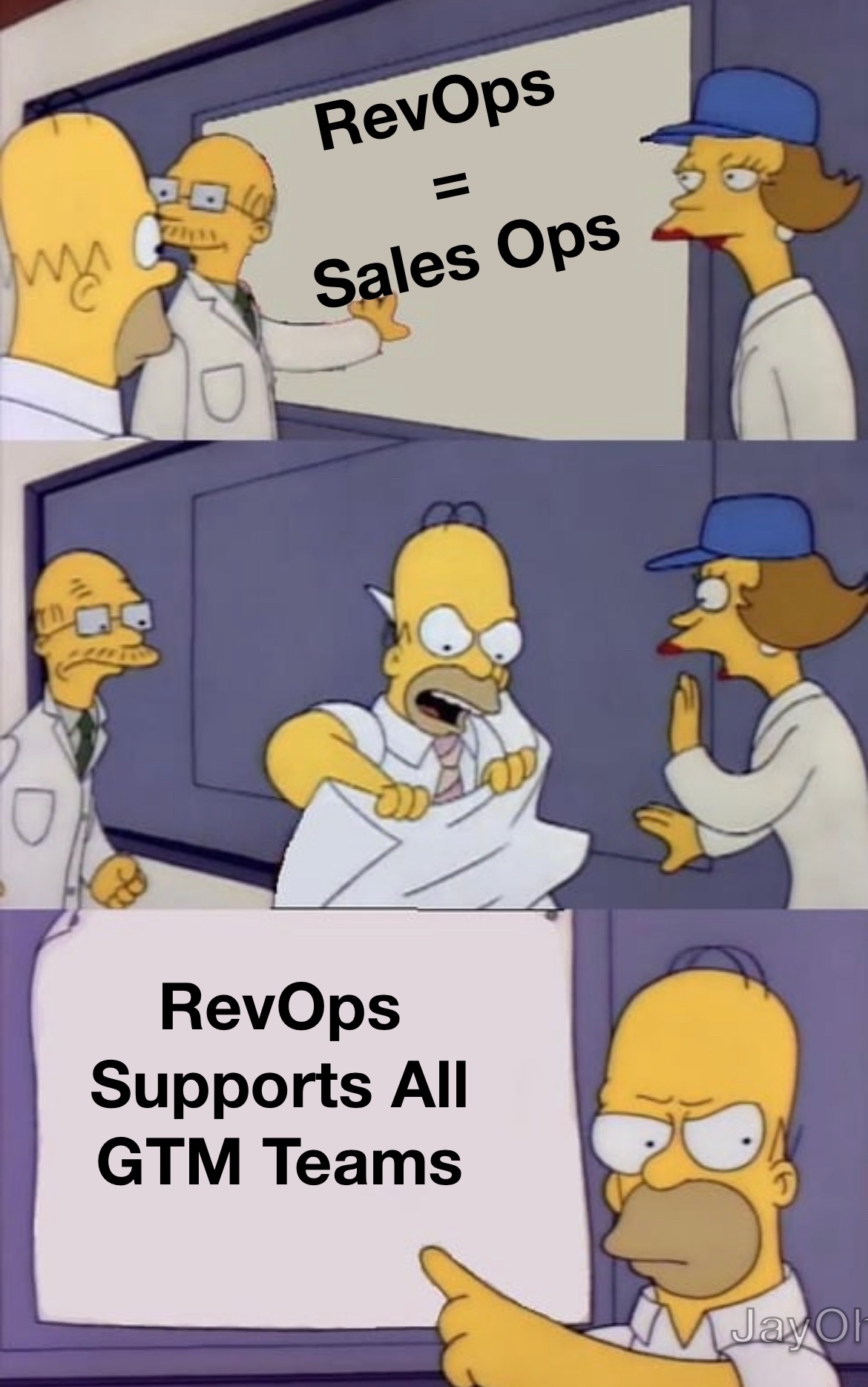
RevOps isn't Sales Ops with a new title. It's the operating system that turns siloed GTM chaos into a unified revenue engine.
| The Issue | Root Cause | The Fix (RevOps Lens) |
|---|---|---|
| Long, unpredictable sales cycles | No unified lead handoff, marketing nurtures low-intent leads, sales wastes time sorting garbage | Implement shared pipeline architecture. Define MQL criteria jointly. Automate qualification workflows. |
| High churn post-sale | Sales closes deals without success team input; no customer health data fed back to renewal forecasts | Create cross-functional onboarding SLAs. Make CS success data visible to renewal sales. Align KPIs (not just revenue targets, but adoption % too). |
| Revenue forecasts miss by >20% | Marketing pipeline opaque to sales, sales doesn't share commit visibility with marketing, finance guesses | Build single source of truth. Real-time dashboard showing marketing pipeline, sales commits, and CS retention signals. |
| Marketing and sales blame each other | No cross-functional metrics. Marketing optimizes for MQLs, sales for closed deals — misaligned incentives | Define unified KPIs: pipeline coverage ratio, forecast accuracy, cost-per-stage, time-to-move metrics. Hold all GTM leaders accountable to same scorecard. |
| Tech stack debt and broken integrations | Tools bolted on ad-hoc. No master data model. Data islands replicate the org silos | RevOps designs the tech stack architecture. Every new tool addition requires integration mapping. RevOps owns data governance and master record management. |
RevOps is not Sales Ops wearing a bigger hat. Sales Ops is a function — it optimizes the sales machine. RevOps is a system — it optimizes the entire revenue machine. The distinction matters operationally and strategically.
Sales Ops might own territory design, CRM field configuration, and sales process workflows. RevOps asks: How do those territories connect to marketing segment strategy? How does the CRM architecture serve finance's reporting layer? What is the upstream marketing process that fills the top of the funnel? What post-sale signals should drive expansion strategy?
When you conflate RevOps with Sales Ops, you:
Unified pipeline definitions, shared stage criteria, cross-functional KPIs, and documented handoff SLAs ensure marketing, sales, and CS move as one organism.
End-to-end, documented revenue processes (lead-to-close, renewal, expansion) with clear ownership, escalation paths, and formal change management discipline.
Single source of truth for pipeline, revenue, and customer data. Automated validation rules, real-time dashboards, and audit trails. Data is a strategic asset.
CRM, marketing automation, CS, and finance systems share data bi-directionally with zero manual entry. Tech stack designed for data flow, not tool proliferation.
GTM leaders articulate channel CAC, LTV, payback period, and forecast accuracy. Finance is embedded in GTM decision-making. Cost-per-stage is visible and owned.
| Level | Name | Characteristics | Typical Impact |
|---|---|---|---|
| 1 | Reactive | No formal RevOps function. Sales Ops handles CRM. Marketing owns its own stack. CS is disconnected. Processes are undocumented and ad-hoc. Data is fragmented. | Revenue misses 20%+. Forecast accuracy <50%. Churn 40%+. GTM waste ~25%. |
| 2 | Defined | RevOps function established, owns CRM. Key processes (lead-to-close) documented. Basic SLAs in place. Some cross-functional metrics defined. Data still siloed but intentional. | Forecast accuracy 65-75%. Churn 30-35%. Sales cycle shortened 10%. GTM waste 18-20%. |
| 3 | Integrated | RevOps spans marketing, sales, CS. All GTM processes documented with clear ownership. Unified pipeline. Cross-functional SLAs enforced. CRM and marketing automation synced. Finance integrated into GTM reviews. | Forecast accuracy 85%+. Churn 20-25%. Sales cycle shortened 20%. GTM efficiency 3:1. Revenue lift 8-12% YoY. |
| 4 | Optimized | Full RevOps operating system deployed. 70%+ process automation. Real-time dashboards. Multi-touch attribution. Tech stack fully integrated. Continuous improvement cadence in place. Finance visibility on all GTM decisions. | Forecast accuracy 90%+. Churn <15%. Sales cycle shortened 30%. GTM efficiency 4:1+. Revenue lift 15-18% YoY. |
| 5 | Predictive | Mature RevOps system with AI/ML-driven forecasting. Predictive lead scoring. Automated risk detection. Dynamic pricing. Scenario planning. RevOps leaders act as strategic revenue architects. ROI on every GTM dollar measurable. | Forecast accuracy 95%+. Churn <10%. Sales cycle shortened 40%. GTM efficiency 5:1+. Revenue lift 20%+ YoY. Predictable, compounding growth. |
| Frequency | Key Actions | Owner |
|---|---|---|
| Daily | CRM hygiene checks, pipeline churn monitoring, critical escalations, lead distribution SLA compliance | RevOps Manager + Sales Ops |
| Weekly | Cross-functional GTM sync (marketing, sales, CS leads review pipeline health, conversion metrics, blockers), forecast updates | RevOps Lead + GTM Leaders |
| Monthly | Deep-dive metrics review (CAC, LTV, payback, churn), process audit, tech stack health check, finance reconciliation | RevOps Lead + CFO / Finance |
| Quarterly | Strategic GTM planning, territory/segment refresh, goal alignment, tool roadmap review, maturity assessment | CRO / VP Revenue + RevOps Lead |
| Annual | RevOps strategic audit, tech stack redesign, organizational realignment, roadmap for next fiscal year | Board / Executive Team + RevOps Lead |
Most teams don't have a RevOps problem. They have a "we think RevOps is just Sales Ops" problem. That mindset costs them 10-20% in annual revenue growth and leaves 25-30% of GTM effort wasted on process friction. The math is simple: unify your GTM function, standardize your processes, connect your data, and watch your revenue machine work 30% more efficiently. That's not an operational upgrade. That's a growth engine.